In an era defined by climate change, urban sprawl, and technological disruption, the very fabric of our cities is being questioned. Can the metropolitan models of the 20th century, with their concentric circles of congestion, pollution, and social stratification, serve the needs of the 21st century? One nation has responded with a resounding “no” and has embarked on the most ambitious urban development project in modern history. This is not merely the construction of a new city; it is the conceptualization of a new way of life. Nestled in the northwest of Saudi Arabia, a colossal undertaking named NEOM is rising from the sands, and at its heart lies its flagship project: The Line, a revolutionary linear city that promises to redefine the future of human habitation. This article delves deep into the vision, technology, challenges, and profound implications of this $500 billion endeavor, exploring whether it can truly become the blueprint for the cities of tomorrow.
A. Understanding the NEOM Megaproject: More Than Just a City
Before we can comprehend The Line, we must first understand the vast canvas upon which it is being drawn. NEOM is not a single city but a regional development spanning over 26,500 km² (approximately 10,230 square miles)—an area larger than Rwanda or Israel. Its name is a portmanteau of the Ancient Greek word “Neos” (new) and the Arabic “Mustaqbal” (future), forming “New Future.” Funded by the Saudi Arabian Public Investment Fund (PIF), NEOM is the cornerstone of the Kingdom’s Saudi Vision 2030, a strategic framework to reduce Saudi Arabia’s dependence on oil, diversify its economy, and develop public service sectors.
NEOM is conceived as a living laboratory a hub for innovation and a magnet for the world’s greatest minds. It is structured into several key regions, each with a specialized focus:
A. The Line: The futuristic, linear urban center we will explore in detail.
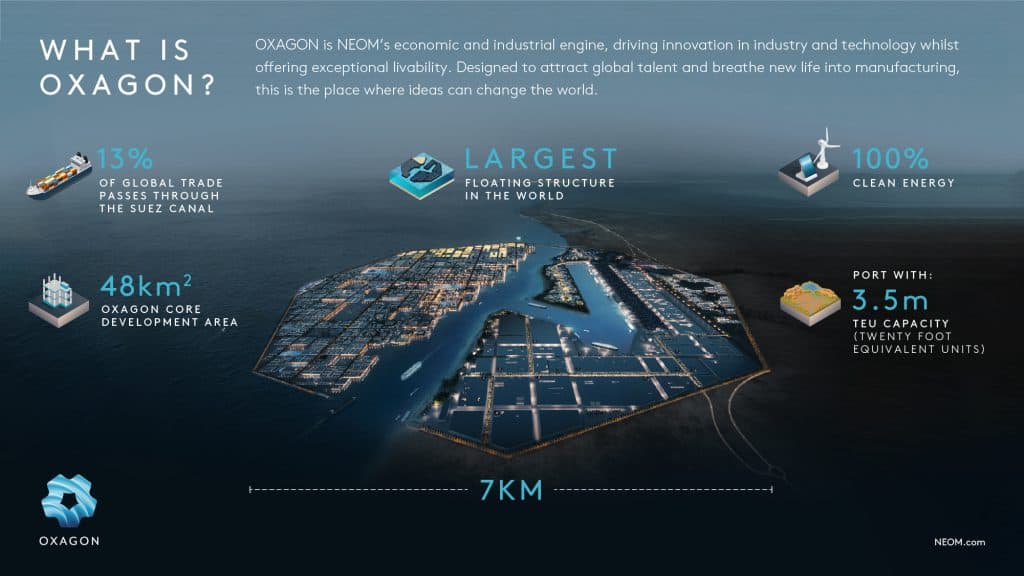
B. Oxagon: Envisioned as the world’s largest floating industrial complex, it will focus on advanced and clean industries, leveraging its strategic location on the Red Sea for global trade.
C. Trojena: A mountain destination set to become a regional leader in outdoor skiing and adventure sports, offering year-round outdoor activities and slated to host the 2029 Asian Winter Games.
D. Sindalah: A luxury island resort in the Red Sea, designed to be a premier tourism destination with a marina, beach club, and world-class golf course.
This multi-faceted approach ensures that NEOM is not a one-trick pony but a comprehensive economic and social engine, aiming to attract businesses, tourists, and residents across various sectors.
B. Deconstructing The Line: A Paradigm Shift in Urban Form
The Line is the project’s most radical and publicized component. It is a direct challenge to conventional urban planning, which has historically favored circular, radial growth. The Line proposes a city of 170 kilometers in length, but only 200 meters wide. It will house 9 million residents in a footprint of just 34 square kilometers, a staggering density that is nonetheless designed to feel entirely different from today’s crowded metropolises.
B.1. The Foundational Philosophy: Zero Cars, Zero Streets, Zero Carbon
The core principle of The Line is a complete departure from the car-centric city model. The designers started with a blank slate, asking what a city would look like if it were built for people, not vehicles. The answer is a city with no roads, no cars, and, consequently, no carbon emissions from transportation. This single decision has cascading benefits:
-
Reclaimed Space: In traditional cities, up to 30-40% of land is dedicated to roads and parking lots. The Line repurposes all this space for public parks, walkways, and community areas.
-
Elimination of Traffic Fatalities: With no cars, traffic accidents a leading cause of death worldwide are eliminated.
-
Clean Air and Quiet: The absence of combustion engines means significantly cleaner air and a drastic reduction in noise pollution, creating a healthier and more serene urban environment.
B.2. The Three-Layer Vertical City: A Model of Functional Integration
To achieve its goals, The Line is conceived as a city of three vertical layers:
-
The Pedestrian Layer (The Surface): This is the ground level, designed exclusively for pedestrians. It is a continuous, open space without streets, interspersed with parks, plazas, and water features. The aim is to create a walkable, human-scale environment where everything essential is within a five-minute walk. This layer is shielded from the harsh desert climate, making outdoor activities pleasant year-round.
-
The Service Layer (The Underground): Below the surface lies a hidden world of infrastructure. This includes utility lines, water pipes, waste management systems, and logistics networks. This is where the “back-of-house” functions of the city operate, ensuring that the surface level remains clean, uncluttered, and focused on human experience.
-
The Spine Layer (The Underground Transport): Also located underground is the city’s high-speed public transit system. This is the lifeblood of The Line, featuring ultra-fast rail and potentially hyperloop technology. The promise is that any end-to-end journey along the 170-kilometer city will take no more than 20 minutes. This layer seamlessly connects all modules of the city, making proximity-based accessibility instantaneous.
C. The Technological Pillars Powering The Line

A city of this ambition cannot exist without cutting-edge technology. The Line is designed to be a massive, integrated smart city, powered by a suite of disruptive technologies.
C.1. Artificial Intelligence and Predictive Services
AI is the “brain” of The Line. A vast network of sensors and Internet of Things (IoT) devices will collect real-time data on everything from energy consumption and traffic flow in the transit spine to waste levels and water usage. This data will be processed by a central AI that will:
-
Optimize Resource Allocation: Dynamically manage electricity, water, and other utilities to eliminate waste.
-
Predict Maintenance Needs: Identify potential issues in infrastructure before they become problems, ensuring near-100% uptime for all city services.
-
Personalize Public Services: Offer tailored suggestions to residents for their daily activities, commutes, and even healthcare, based on anonymized and aggregated data.
C.2. A Symphony of Renewable Energy
To achieve its 100% renewable energy goal, The Line will leverage the abundant natural resources of its location.
-
Solar Power: Vast solar farms in the surrounding desert will capture the intense sunlight, generating gigawatts of clean electricity.
-
Wind Power: The coastal location provides consistent wind patterns, which will be harnessed by both onshore and offshore wind turbines.
-
Green Hydrogen: As a potential energy storage and export solution, NEOM is already investing heavily in green hydrogen production, created using renewable energy.
The city’s energy grid will be a smart grid, using AI to balance supply and demand, store excess energy, and ensure a constant, reliable power supply without fossil fuels.
C.3. Advanced Water Management and Circular Economy
Located in a water-scarce region, The Line must be a pioneer in water sustainability. The strategy involves:
-
Large-Scale Desalination: State-of-the-art, energy-efficient desalination plants will provide fresh water. These plants will be powered entirely by renewable energy to avoid the high carbon footprint typically associated with desalination.
-
Water Recycling and Reuse: A closed-loop water system will treat and recycle greywater and blackwater to the highest standards, reusing it for irrigation, industrial processes, and even replenishing natural aquifers.
-
Circular Waste Management: The city aims for a zero-waste-to-landfill model. All waste will be seen as a resource. Organic waste will be composted or converted to energy, plastics will be recycled, and advanced processes will handle electronic and construction waste.
D. The Human and Social Dimension: A Livable Future?
Beyond the technological marvels, the ultimate success of The Line will be measured by its livability. The design prioritizes human well-being and social cohesion in unprecedented ways.
-
Access to Nature: By eliminating cars and dedicating the surface to pedestrians, residents will have constant, immediate access to green spaces. The compact design means that the vast, untouched desert and the Red Sea coast are never more than a short train ride away.
-
Health and Well-being: The built environment is designed to promote physical activity through walking and cycling. Clean air, a healthy diet promoted by local vertical farming, and a stress-free commute are all factored in as contributors to public health.
-
Community and Social Equity: The five-minute city concept ensures that all essential services schools, clinics, leisure facilities are accessible to everyone, reducing social and economic disparities based on location. The city is designed to be inclusive, aiming to attract a diverse population of global citizens.
E. Confronting the Challenges and Criticisms
No project of this scale is without immense challenges and valid criticisms. A sober analysis must consider the hurdles The Line faces.
-
The Immense Scale and Cost: The projected cost is over $500 billion. While the PIF is one of the world’s largest sovereign wealth funds, economic shifts or budget overruns could jeopardize the project’s full realization.
-
Technological Feasibility and Integration: Many of the proposed technologies, especially the AI management system and the ultra-high-speed transit, are at the very cutting edge. Integrating them seamlessly into a single, functioning organism is an unprecedented engineering challenge.
-
Environmental and Ecological Impact: While designed to be sustainable, the construction itself has a significant footprint. The 170-kilometer-long structure will inevitably disrupt desert ecosystems, migratory paths of animals, and the local hydrology. The project leads state they are conducting extensive environmental impact assessments and aim for a net-positive environmental outcome, but this remains a point of intense scrutiny.
-
Social and Cultural Viability: Can a pre-planned, algorithmically managed city foster the organic, chaotic, and often messy social interactions that give traditional cities their soul and character? There are concerns about a potential surveillance state, given the level of data collection required for the AI to function. Furthermore, attracting 9 million people to a completely new and untested social model in a remote location is a massive demographic challenge.
-
Geopolitical and Logistical Complexities: The location borders Jordan and Egypt and is close to Israel and the busy shipping lanes of the Red Sea. This presents both an opportunity for international cooperation and a potential risk from regional instability.
F. The Global Implications: A Template for Tomorrow?
If successful, even partially, The Line’s impact will reverberate far beyond Saudi Arabia’s borders.
-
A Laboratory for Urban Innovation: The technologies and planning principles developed for The Line could be adapted and scaled for use in existing cities and new developments worldwide. Its successes and failures will provide invaluable data for the future of urbanism.
-
Accelerating the Green Transition: By proving that a large, modern city can run entirely on renewables, The Line could accelerate the global shift away from fossil fuels, demonstrating the commercial and practical viability of a zero-carbon future.
-
Redefining National Economies: For Saudi Arabia and other resource-rich nations, NEOM represents a tangible path toward a post-oil economy, built on knowledge, innovation, and tourism.
Conclusion: A Journey into the Unknown
The Line is more than a construction project; it is a statement of ambition and a bet on the future. It is a vision that dares to imagine a world where technology serves humanity, where development works in harmony with nature, and where the chronic problems of modern urban life are solved not with incremental fixes, but with a radical reinvention. The path ahead is fraught with technical, financial, and social obstacles, and the final form of The Line may differ from the renders we see today. Yet, its very conception has already succeeded in one crucial aspect: it has forced urban planners, technologists, and citizens worldwide to dream bigger and to demand more from the cities we call home. Whether it becomes a fully realized utopia or a partially implemented prototype, The Line has irrevocably shifted the conversation about what is possible in the 21st century and beyond. The world is watching, for the story of The Line is, in many ways, a preview of our own collective future.