In an era defined by rapid urbanization and digital transformation, cities worldwide grapple with a universal challenge: how to harmonize economic growth, environmental sustainability, and an enhanced quality of life. While many nations theorize about the cities of tomorrow, Singapore has consistently moved from blueprint to reality, establishing itself as a global laboratory for urban innovation. Its latest and most ambitious project to date, the Punggol Digital District (PDD), is not merely another business park or residential annex. It represents a fundamental reimagining of urban ecosystems, a living testament to Singapore’s “Smart Nation” vision where digital technology, community, and nature converge seamlessly. This district is engineered to be more than just a place of work and study; it is a proactive, responsive, and deeply integrated environment designed to anticipate the needs of its inhabitants and the planet. This in-depth exploration delves into the multifaceted layers of the Punggol Digital District, unpacking its strategic vision, groundbreaking technological integrations, sustainable architecture, and its profound implications for the future of urban living on a global scale.
A. The Foundational Vision: More Than Just Bricks and Mortar
The conception of the Punggol Digital District is rooted in a forward-looking strategy that transcends conventional urban development. Its core purpose is to create a synergistic ecosystem where academia, industry, and the community co-create and thrive together. This vision is materialized through three key pillars:
A. The Integration of Academia and Industry: At the heart of PDD lies a unique collocation model. It is the designated home for the Singapore Institute of Technology (SIT)’s new flagship campus and the national cybersecurity agency, the Cyber Security Agency of Singapore (CSA). More than just neighbors, these institutions are woven into the fabric of the district alongside key industry players in the digital and tech sectors. This physical proximity is designed to break down traditional silos, fostering a dynamic environment for cross-pollination of ideas. SIT’s applied learning pedagogy means students will work on real-world projects with companies located just steps away, ensuring a pipeline of industry-ready talent and driving innovation directly from the campus into the commercial sphere.
B. A Catalyst for the Digital Economy: PDD is strategically positioned to anchor Singapore’s ambitions in the digital realm. By concentrating high-growth sectors like cybersecurity, fintech, and information technology within a purpose-built environment, it creates a powerful cluster effect. This attracts multinational corporations, vibrant startups, and top-tier talent, establishing a critical mass that accelerates research, development, and commercialisation. The district is poised to become the nation’s nerve center for the Fourth Industrial Revolution (Industry 4.0), focusing on areas such as artificial intelligence, data analytics, and the Internet of Things (IoT).
C. A Test-Bed for Nationwide Solutions: PDD serves as a large-scale living laboratory. The technologies, urban solutions, and governance models pioneered here are not isolated experiments. They are designed to be scalable, replicable frameworks that can be adopted across other parts of Singapore and potentially, the world. Every success and lesson learned within the district’s confines provides invaluable data and proof-of-concept for future urban developments, solidifying Singapore’s role as a thought leader in smart city design.
B. The Digital Backbone: An Orchestra of Intelligent Systems
What truly distinguishes Punggol Digital District is its deeply integrated digital infrastructure, which acts as the central nervous system of the entire area. This is not a mere assemblage of smart apps, but a holistic, platform-driven approach that connects every facet of the urban experience.
A. The Open Digital Platform (ODP): The cornerstone of PDD’s intelligence is its Open Digital Platform. Imagine a central, shared digital “brain” that allows various systems energy, water, waste, mobility, security to communicate with one another. Developed in collaboration with JTC (Singapore’s leading industrial infrastructure developer) and GovTech, the ODP aggregates real-time data from thousands of sensors deployed throughout the district. This platform enables different service providers and government agencies to develop integrated solutions. For instance, the ODP can analyze footfall data from public spaces, combine it with public transport schedules and weather information, and dynamically adjust the frequency of shuttle buses and the cooling in nearby buildings to optimize energy consumption and commuter comfort.
B. Intelligent Mobility and Logistics: Transportation within PDD is redefined for efficiency and sustainability.
* Smart Traffic Management: A network of sensors and AI-powered analytics will monitor traffic flow in real-time, predicting congestion hotspots and adjusting traffic light sequences proactively to ensure smooth movement. This reduces idling times, lowering vehicle emissions.
* Consolidated Automated Logistics: In a world-first for a district-scale development, PDD features a common underground logistics system. Automated Guided Vehicles (AGVs) will operate in dedicated tunnels to transport goods between a central distribution center and the various buildings. This eliminates the need for large, polluting delivery trucks on the surface roads, reducing traffic congestion, noise pollution, and carbon footprint, while creating a far more efficient last-mile delivery system.
* Seamless Multi-Modal Transit: The district is intricately linked to the Punggol Coast MRT station, encouraging the use of public transport. Within the district, a fleet of autonomous shuttles and a comprehensive network of cycling and pedestrian paths, complete with smart bicycle parking systems, provide convenient and eco-friendly “first and last mile” connectivity.
C. Data-Driven Facilities Management: Building operations are elevated to a new level of precision. Smart sensors monitor occupancy levels in offices, lecture halls, and public areas, allowing for the optimization of lighting, air conditioning, and ventilation. This not only ensures occupant comfort but also leads to significant energy savings a critical consideration for a resource-conscious nation like Singapore. Predictive maintenance, powered by data analytics, can alert facilities managers to potential equipment failures before they occur, minimizing downtime and repair costs.
C. The Green Lung: Weaving Sustainability into the Urban Fabric
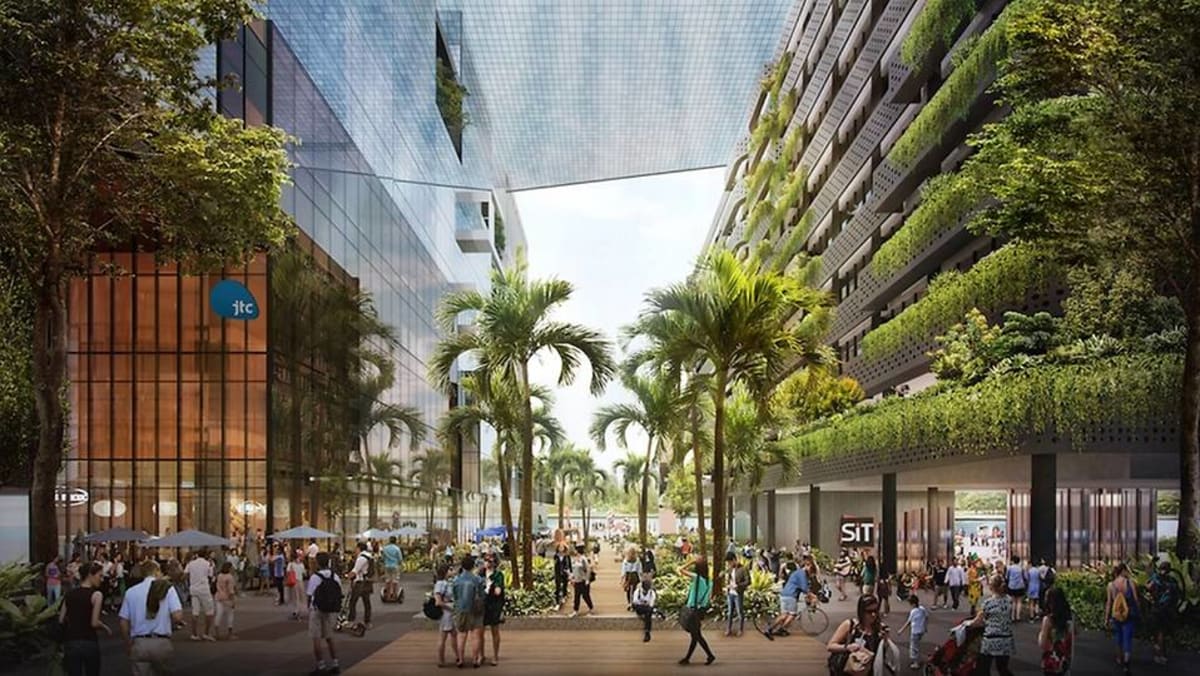
The Punggol Digital District is a powerful rebuttal to the notion that technological advancement must come at the expense of the environment. It is a masterclass in biophilic design, where nature is not an afterthought but a core component of the urban plan.
A. A District in a Park: Instead of a “park in a district,” PDD is conceived as a “district in a park.” A significant portion of the land is dedicated to green spaces, including the extension of the existing Waterway Park. Lush greenery, water bodies, and native landscaping are woven throughout, creating a serene and visually appealing environment that promotes biodiversity and improves the mental well-being of residents, workers, and students.
B. Climate-Responsive Architecture: Buildings are designed to be inherently sustainable. They incorporate passive design strategies such as optimal orientation to minimize solar heat gain, extensive shading devices, and natural ventilation wherever possible. The extensive use of green roofs and vertical gardens not only insulates buildings and reduces the urban heat island effect but also manages stormwater runoff and provides habitats for urban wildlife.
C. Closed-Loop Resource Management: PDD champions the principles of a circular economy.
* Energy: The district leverages smart grids to optimize electricity distribution and is primed for the integration of renewable sources, such as solar panels installed on building rooftops.
* Water: An advanced water management system promotes the collection and use of NEWater (high-grade reclaimed water) and harvested rainwater for non-potable uses like irrigation and cooling, significantly reducing the demand on the public water supply.
* Waste: A centralized, automated waste collection system uses a pneumatic network to transport waste from buildings to a central collection point. This not only improves hygiene by removing refuse trucks from the streets but also facilitates more efficient sorting and recycling, moving the district closer to a zero-waste goal.
D. The Human-Centric Community: Fostering Connection and Well-being
Amidst all the talk of technology and sustainability, the ultimate success of PDD hinges on its ability to create a vibrant, inclusive, and human-centric community. The design consciously prioritizes spaces and experiences that foster social interaction, learning, and a strong sense of belonging.
A. Dynamic Public and Shared Spaces: The district plan is rich with a variety of public plazas, pocket parks, and community gardens. These are not static areas but are activated by public art installations, pop-up markets, and community events. Furthermore, the concept of shared amenities is central. Instead of each company having its own underutilized cafeteria or meeting room, PDD promotes shared facilities like a central food hall, co-working spaces, and innovation centers. This not only reduces the physical and carbon footprint of the district but also creates natural collision points for people from different companies and institutions to meet, network, and collaborate.
B. The Singapore Institute of Technology as a Community Anchor: The integration of SIT’s campus is a masterstroke in community building. The university’s facilities, including its libraries, sports complexes, and auditoriums, are designed to be accessible to the public. This transforms the campus from an isolated ivory tower into a vibrant community hub where lifelong learning is encouraged, and the boundaries between student, professional, and resident are blurred.
C. Inclusive and Accessible Design: From its inception, PDD has been planned with universal accessibility in mind. The district is designed to be navigable and enjoyable for everyone, regardless of age or ability. Barrier-free access, clear signage, and safe, well-lit pedestrian pathways ensure that the benefits of this smart district are equitably shared by all members of the community.
E. Challenges and Global Implications of the PDD Model
While the vision for Punggol Digital District is undeniably impressive, its implementation is not without challenges. Navigating these complexities offers crucial lessons for other cities.
A. Navigating the Challenges:
* Data Privacy and Cybersecurity: A district that runs on data is inherently vulnerable to cyber threats and raises significant privacy concerns. The very sensors that optimize traffic and energy use can be misused for pervasive surveillance. A robust, transparent regulatory framework governing data collection, usage, and protection is paramount. The presence of the Cyber Security Agency of Singapore within the district is a strategic advantage, allowing for the real-world testing and development of cutting-edge cybersecurity protocols.
* Digital Inclusivity: As services become increasingly digital, there is a risk of alienating segments of the population who are less tech-savvy, particularly the elderly. Ensuring that non-digital alternatives and comprehensive digital literacy programs are in place is critical to prevent the creation of a new form of social divide.
* Economic Viability and Long-Term Maintenance: The initial capital investment for such advanced infrastructure is enormous. Furthermore, the long-term maintenance of these complex systems requires a highly skilled workforce and sustained financial commitment. Ensuring the economic model is viable for both the government and private tenants is essential for the district’s long-term success.
B. A Replicable Blueprint for the World: The Punggol Digital District is more than a Singaporean project; it is a global prototype. For burgeoning megacities in Asia and Africa, it offers a model for leapfrogging traditional, often messy, urban development stages. For established cities in Europe and North America, it provides a framework for retrofitting and revitalizing older districts with smart, sustainable technologies. The key takeaway is the holistic, platform-based approach. It demonstrates that success lies not in deploying isolated smart solutions, but in creating an integrated, interoperable system where technology serves a clear, human-centric purpose aligned with broader economic and environmental goals.
Conclusion: The Dawn of a New Urban Age
The Punggol Digital District stands as a bold declaration of Singapore’s unwavering commitment to shaping its own future. It is a complex, multi-layered ecosystem that seamlessly blends the digital with the physical, the economic with the environmental, and the institutional with the communal. It moves beyond the hype of “smart cities” to deliver a tangible, functioning model of what urban life in the 21st century can and should be: efficient, sustainable, and profoundly human. As the district becomes fully operational in the coming years, the world will be watching closely. The data it generates, the solutions it validates, and the community it nurtures will provide an invaluable playbook for building resilient, livable, and future-ready cities across the globe. The Punggol Digital District is not just a place on a map; it is a living promise of a smarter, greener, and more connected urban future for all.